
Jewish Last Names and Meanings
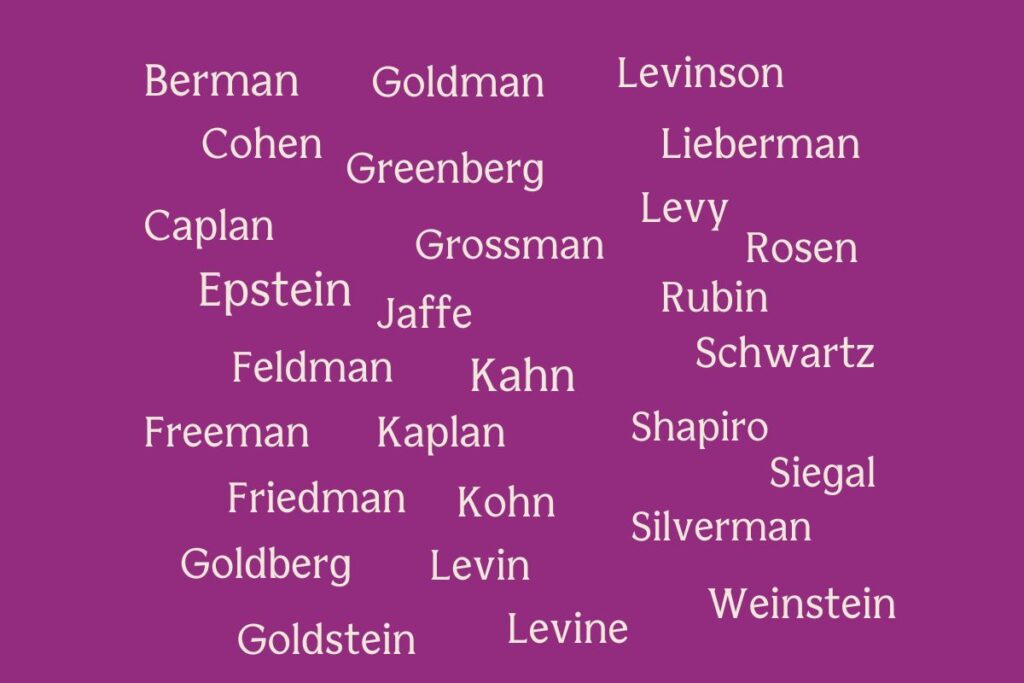
If you’re curious about Jewish surnames—where they come from, what they mean, and how they’ve evolved—this article gives you a solid overview aimed at an English-speaking (U.S.) audience. While no surname guarantees Jewish heritage, many Jewish last names carry rich histories and meanings worth exploring.
1. Why Jewish surnames matter
Before diving into specific names, it helps to understand how Jewish last names developed, and why they tell more than just “family name.”
- Historically, many Jewish people did not use fixed surnames. In traditional Jewish practice, one might be known as “David ben Joseph” (David, son of Joseph) rather than a family surname.
- The adoption of hereditary surnames became common in different Jewish communities at different times—for example, among Sephardic Jews (Spain/Portugal/Italy) earlier, and among Ashkenazic Jews (Germany, Eastern Europe) often in the 18th-19th centuries when governments required fixed surnames.
- Jewish surnames often reflect one of several patterns:
- Patronymics: “Son of / daughter of” someone (e.g., Abramson = "son of Abram")
- Occupational names: relating to a job (e.g., Sofer = scribe)
- Toponymic / geographic names: based on place of residence or origin (e.g., Berliner = from Berlin)
- Descriptive or ornamental names: based on colors, nature, qualities, or simply chosen because they sounded nice or met local naming laws (e.g., Blum = “flower”)
- It’s important to note: having a surname common among Jews doesn’t automatically mean someone is Jewish. There’s overlap with non-Jewish populations; many names are used by multiple groups.
- Understanding surname origins can be a fun gateway into family history, migration, culture, and identity.
2. Some common Jewish surnames & what they mean
Here are several well-known Jewish last names (mostly Ashkenazic, but some Sephardic/Mizrahi) along with their origins and meanings.
| Surname | Meaning / Origin | Notes |
|---|---|---|
| Cohen (variants: Kohn, Kahn, Kagan, etc.) | “Priest” in Hebrew – historically from the priestly class in Israel. | Very common; often indicates ancestral claim (though not guaranteed). |
| Levy / Levi / Levine / Levitt | Descendant of the tribe of Levi (one of the 12 tribes of Israel). | Often linked to liturgical or temple service roles historically. |
| Abrams / Abramson | “Son of Abram / Abraham” – referencing the Biblical patriarch Abraham. | Patronymic form. |
| Goldberg | “Gold mountain” (gold + berg) – could reflect wealth, occupation, or geographic feature. | Typical of Ashkenazic style combining German/Yiddish elements. |
| Friedman / Fridman | “Man of peace” (from Yiddish/German friede = peace). | Reflects value or ideal rather than occupation or place. |
| Haddad | “Blacksmith” (from Arabic / Semitic root) – common among Mizrahi Jews (Middle East/North Africa). | Shows how Jewish surnames also reflect broader regional contexts beyond Europe. |
| Meyer / Meier / Mayer | From Middle High German meiger, meaning “manager of a lord’s estate” or “headman of a household”; among Jewish families also connected with Hebrew name Me’ir meaning “enlightened/shining.” | Illustrates how names could be adopted and assimilated across languages. |
| Klee | German/Ashkenazic: in German, “clover”; for Jewish families in Alsace since the 18th century. | Example of a relatively “non-obvious” Jewish surname. |
3. Patterns & suffixes you’ll often see
When you look at Jewish surnames, especially Ashkenazic ones, you’ll notice certain recurring suffixes, roots, or patterns. Understanding them helps you recognize the origin.
- Suffixes like -son, -s, -owitz, -ovitch, -witz often indicate “son of” in Eastern European usage.
- Place-based names might end in -berg (mountain), -stein (stone), -feld (field) — common in German/Yiddish contexts.
- Some names are occupational: Sofer (scribe), Kantor (cantor), etc.
- Some are descriptive or ornamental: Blum (flower), Weiss (white), Grün/Green (green) — often adopted when Jews were required to select surnames in various regions.
4. Why origins differ (Ashkenazic vs Sephardic vs Mizrahi)
Jewish communities around the world experienced different histories, which shaped their naming conventions.
- Ashkenazic Jews: from Central and Eastern Europe. Many surnames reflect German/Yiddish language, European occupations, German-style ornamentals, or place names.
- Sephardic Jews: originally from Spain and Portugal, later dispersed. Some names reflect Iberian origins, Hebrew or Ladino usage, and local geographies.
- Mizrahi Jews: from the Middle East and North Africa. Names often reflect Arabic/Hebrew roots, local occupations, or locations (e.g., Haddad = blacksmith).
- Because of migrations, assimilations, and name changes (for legal, social, or safety reasons), Jewish surnames today may reflect a mix of influences.
5. Things to keep in mind (and caveats)
- A surname alone cannot prove someone’s background or faith. Many names are shared across communities or adapted over time.
- Some Jewish families changed or adapted their surnames when immigrating (for example, to the U.S.), so direct translation or meaning may be obscured or lost.
- Spelling variations are common (Levy, Levi, Levine; Cohen, Kohn, Kagan, etc.).
- Some surnames originally had one meaning but took on new associations in Jewish contexts.
- If you’re doing genealogical research: looking at the surname’s linguistic origin, region of usage, historical immigration records, and local contexts will give more accurate insight than relying on “this is obviously Jewish.”
6. Why this is helpful (and fun)
- If you’re creating content (for example, a YouTube video about names or culture), knowing these surname meanings can give cultural depth or relevance.
- If you’re exploring your own family tree, understanding surname meaning can spark curiosity, reveal migration paths, or help connect to historical communities.
- It’s a way to appreciate how much history is embedded in something as simple as a last name: language, occupation, geography, culture, and religion.
7. Closing thoughts
Jewish surnames are a window into centuries of migration, adversity, adaptation, and identity. From the priestly lineage suggested by Cohen, to the occupational hint in Haddad, or the geographic trace in Meyer — each name has a story.
If you’re curious about your surname (or one you found interesting), you might ask:
- What language does the name look like (Hebrew, German, Polish, Arabic, etc.)?
- Does it end in a suffix suggesting “son of” or a place (-son, -witz, -berg)?
- Could it reflect a job, a geographical feature, or an attribute?
- What region did the family likely come from (Eastern Europe, Iberian Peninsula, Middle East)?
Answering those questions can help you unlock the name’s meaning and context.
Related Articles